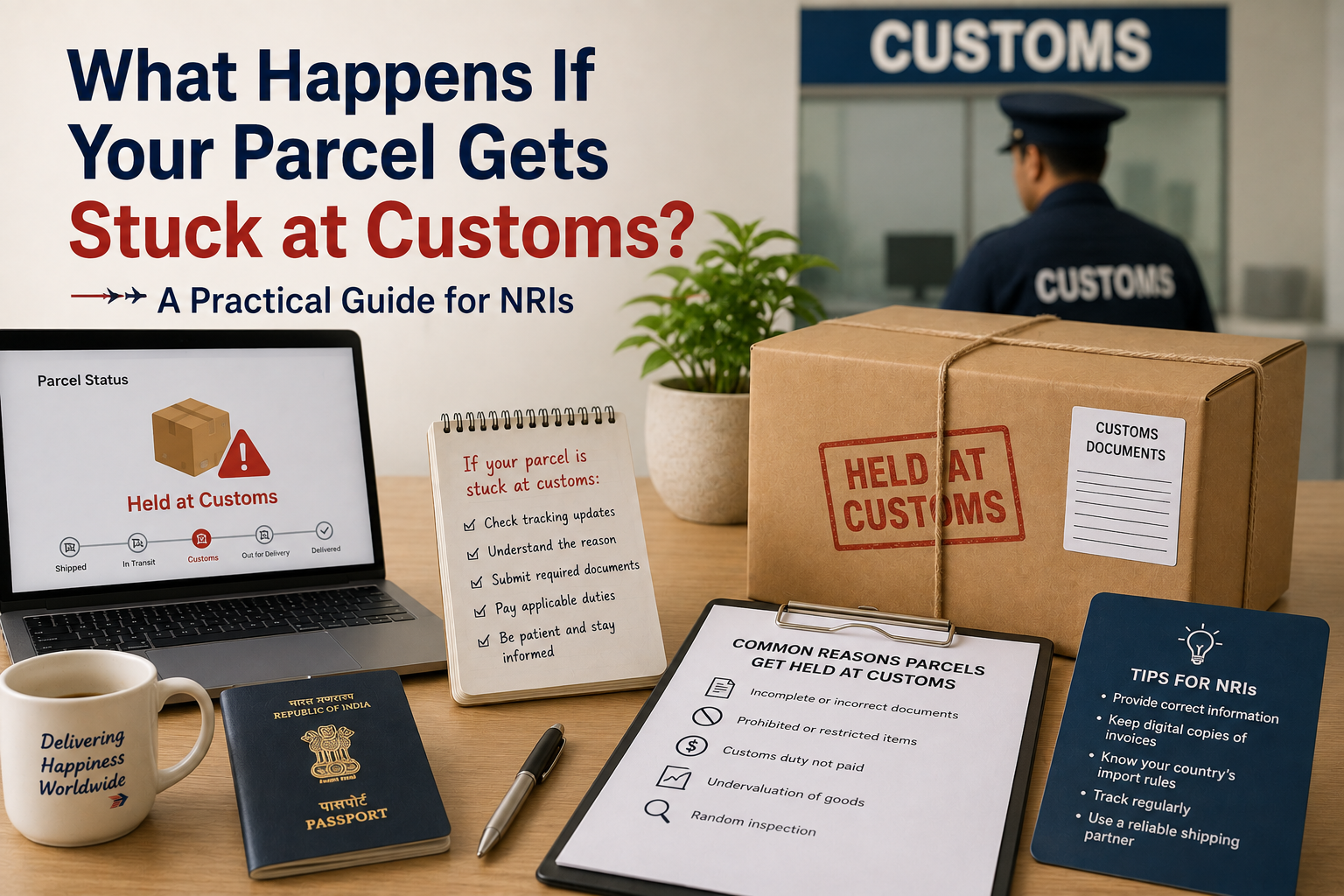
You have been checking the tracking page every few hours. The parcel left Hyderabad on schedule, cleared the origin export check, flew into Dubai or Heathrow, or Changi, or JFK and then stopped. The status line reads something like Held in customs or Clearance delay or sometimes just In transit with a timestamp that stopped updating three days ago.
This is the moment that turns reasonable people into anxious ones. The package contains things you need. You paid for shipping. And now it is sitting somewhere in a warehouse that you cannot see, controlled by a process you do not fully understand.
Here is the honest truth: a customs hold is almost never as serious as it feels. In the vast majority of cases it resolves on its own within 2 to 5 business days, sometimes with no action required from you at all. What matters is understanding why it happens, what the tracking status actually means, and what if anything you need to do.
First, what held in customs actually means
Every international parcel entering a country passes through a customs authority. This is not optional and not a sign that something has gone wrong. The customs office checks what is inside the package, compares the declared value against the commercial invoice, assesses whether any import duty or tax is owed, and decides whether the contents comply with local import rules.
Most parcels clear this process in a matter of hours. Some are flagged for a closer look a physical inspection, a document review, a question about declared value, or simply a random check. Being flagged does not mean something is wrong. It means a customs officer needs one more look before releasing the shipment.
The tracking update held in customs or clearance pending simply means the parcel is in this review queue. It has not been seized. It has not been confiscated. It is waiting.
The five most common reasons a parcel is held and what each one requires from you
Reason 1: The declared value looks inconsistent
This is the most common trigger for a hold. If the declared value on the customs invoice does not match the purchase price listed on the commercial invoice from the retailer, or if the value seems suspiciously low for the category of goods, a customs officer will flag it for review.
What you need to do: nothing immediately. In most cases, the courier DHL, FedEx, or UPS will contact you by email or phone requesting a copy of the original purchase receipt or invoice. Have this ready. A screenshot of your Amazon India or Flipkart order confirmation showing the purchase price is usually sufficient. Send it promptly when asked.
Reason 2: A document is missing or has an error
Commercial invoice, packing list, airway bill international shipments require a full set of correctly completed paperwork. A missing field, an incorrect HS code on the product classification, or a mismatch between the declared contents and the physical box are all grounds for a hold.
Forward Parcel generates all customs documentation automatically from your dashboard before any shipment is dispatched, which eliminates most of this risk at source. But if a hold does occur for documentation reasons, the courier will typically contact you with a specific list of what is needed. Respond quickly delays in this scenario are directly correlated with how fast the receiver responds to the courier’s request.
Reason 3: Duties and taxes are unpaid
For shipments above the duty-free threshold of your destination country AED 300 in the UAE, SGD 400 in Singapore, £135 in the UK, and so on import duty and local tax apply. Most courier shipments via DHL, FedEx, and UPS operate on a DDU basis (Delivered Duty Unpaid), meaning the duty is collected from the recipient at or before delivery rather than prepaid at origin.
When your parcel reaches the customs clearance stage and duties are assessed, the courier will notify you usually by email or SMS with the exact amount owed and a payment link. Until that payment is made, the parcel sits in the clearance facility. This is not a hold in the alarming sense it is a straightforward payment request. Pay it, and the parcel is usually released and delivered within 24 to 48 hours.
Reason 4: A physical inspection has been triggered
Customs authorities at every major destination Dubai, Heathrow, Changi, JFK, Kingsford Smith carry out random physical inspections on a percentage of inbound parcels. This is unrelated to the contents of your specific shipment. Your box was selected by a sampling algorithm, not because customs suspects anything.
Physical inspections take 2 to 7 business days depending on workload at the customs facility. There is usually nothing required from you during this period. The parcel will resume transit once the inspection is completed. The tracking will update when the parcel is released.
Reason 5: The shipment contains a restricted or prohibited item
This is the scenario that requires the most attention. Every country maintains a list of goods that are either prohibited entirely or restricted to specific import conditions certain foods, medicines, supplements, aerosols, battery configurations, plant-based products, and so on.
If a customs officer identifies a restricted item in your parcel, the response depends on the destination country and the nature of the restriction. In many cases, the item is removed and the rest of the parcel is released and delivered. In more serious cases, the entire parcel may be held pending documentation proving import compliance, or returned to origin.
The best protection against this scenario is checking the prohibited items list before building your shipment Forward Parcel maintains a prohibited items list on their website that covers destination-specific restrictions. Items that are ambiguous some herbal supplements, certain food categories, specific beauty products are worth checking individually before including them.
How long does a customs hold typically last?
This varies by country and by reason, but the general ranges are:
For routine holds and document requests 2 to 5 business days once the required documents or payment are provided.
For physical inspections 3 to 7 business days at most major airports and sorting hubs. Longer during peak seasons: the period around Diwali, Christmas, and major summer sale windows sees higher parcel volumes and proportionally longer inspection queues.
For restricted item reviews highly variable. Can be as short as 2 days if the item is simply removed and the parcel released, or as long as 2 to 3 weeks if import permits or additional documentation are being assessed.
For genuine prohibitions or serious documentation issues the parcel can be held until resolved or ultimately returned to origin if the issue cannot be resolved.
The practical rule: if your tracking has shown held in customs for more than 5 business days with no communication from the courier, contact the courier directly DHL, FedEx, or UPS customer service with your tracking number. They can pull the specific status from the destination customs authority and tell you exactly what is blocking release.
What the courier does on your behalf
This is the part most NRIs do not realise. When you ship via DHL, FedEx, or UPS, the courier acts as your customs broker at the destination. They submit the import declaration on your behalf, interface with the customs authority, and handle the administrative side of clearance. You do not need to contact the destination customs office yourself the courier is your representative in that process.
Your involvement is limited to: responding promptly when the courier requests documents or payment, and being reachable on the contact number and email address associated with your shipment. If the courier cannot reach you, the parcel waits. This is why having a current, monitored email address and international phone number on your Forward Parcel account matters.
How Forward Parcel reduces customs hold risk at source
Most customs problems are paperwork problems, and most paperwork problems are preventable. Forward Parcel’s consolidation process builds the customs documentation before the box is sealed commercial invoice, packing list, and declared values are generated directly from your approved item list on the dashboard, ensuring that what the customs officer reads on the paperwork matches what is physically in the box.
The photo verification step matters here too. Before you approve a shipment, you see every item photographed. This means you know precisely what is in the box, which allows you to accurately approve the declared contents rather than guessing from a list. Accurate declaration is the single most effective protection against a customs hold.
Prohibited or restricted items caught at the photo review stage can be removed before the box is sealed a far better outcome than having a parcel held at Dubai or Heathrow customs while you try to sort it remotely.
The one thing that makes every customs hold worse
Not checking your email.
When a customs hold occurs, the courier sends a notification sometimes within hours of the flag being raised. That notification either asks for a document, requests a duty payment, or provides instructions for what happens next. Every day that email sits unread is a day the parcel sits in a clearance facility.
Set your courier notifications to go to a mailbox you check daily. Save the DHL, FedEx, or UPS customer service number for your destination country in your phone before your shipment departs. If something happens, you will be ready to respond within hours rather than days and that difference alone resolves most customs holds before they become a genuine problem.
A parcel held at customs is an inconvenience, not a crisis. With accurate paperwork, a responsive email inbox, and the right courier on your side, virtually every hold resolves. The parcels that stay stuck are almost always the ones where nobody was watching.