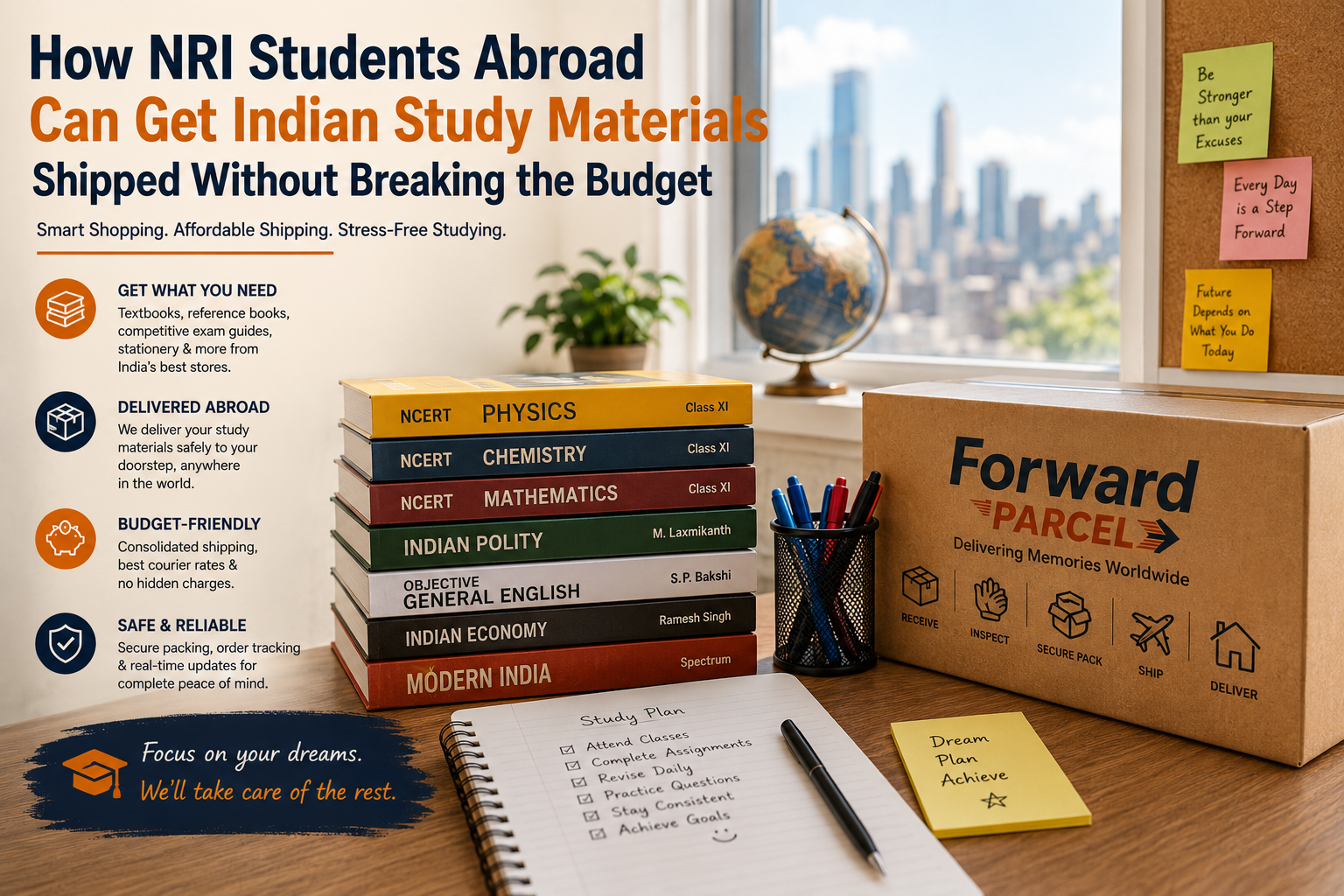
There is a very specific kind of panic that hits Indian students a few weeks after landing abroad.
It usually starts with a WhatsApp message to a parent: “Amma, can you send me my Maths reference book? The one on the shelf, blue cover, next to the dictionary.” Then comes the second message, the one with the shipping quote attached. And then the silence.
Sending a box of books from India to the UK, USA, or Australia can cost as much as the books themselves sometimes more. Parents end up asking relatives. Relatives forget. Books arrive six weeks late, bent at the corners, wedged into a box that clearly had other priorities.
It doesn’t have to work this way. If you are a parent trying to support your child studying abroad, or a student who just realised that your course textbook costs three times as much in London as it does on Flipkart India this guide is for you.
What Students Actually Need Shipped (It’s Not Just Books)
When NRI students and their parents talk about “study materials,” they usually mean something broader than textbooks. The full list tends to include:
Reference books and textbooks – NCERT titles, competitive exam guides, regional language books, subject reference books that simply don’t exist outside India or are prohibitively priced abroad.
Stationery and geometry equipment – Camlin geometry boxes, quality Indian-made drawing sheets, specific stationery that students grew up using and find oddly hard to replicate abroad.
Printed notes and documents – Spiral-bound notes from coaching classes, printed study material from institutes, photocopied exam archives.
Comfort and cultural essentials Homemade dry snacks (chakli, mathri, chivda), specific Indian brands of tea, instant meal mixes, festival items, and seasonal clothing like woollen shawls or salwar sets that don’t cost a fortune in India but would cost a fortune to buy locally.
The last category matters more than most parents realise. A box that travels from home is not just logistics it is morale. Students who feel connected to home settle faster, focus better, and worry less. The contents of that box are doing emotional work as much as academic work.
Why Sending Things One at a Time Is So Expensive
Here is where most families go wrong. They send things as they are needed one book when it’s urgently required, a jacket when winter arrives, snacks when homesickness peaks. Each shipment is small, each shipment is urgent, and each one attracts the full per-shipment cost of international courier rates.
International Speed Post (EMS) from India to the USA or UK charges approximately ₹865 for the first 250g, with an additional ₹100 per 250g slab after that. That means a single 1 kg book sent urgently to London costs roughly ₹1,265 in postage alone before customs, before packaging, before the trip to the post office.
Send four books separately over a semester? You’ve spent more on postage than the books cost.
The solution is consolidation gathering everything into one well-planned shipment rather than sending items piecemeal. And this is exactly where a parcel forwarding service changes the equation entirely.
How Consolidation Works (And Why It Saves So Much)
When you use a parcel forwarding service, your family gets a dedicated Indian shipping address typically a warehouse address. They order from any Indian platform they want: Flipkart, Amazon.in, a local bookstore’s online shop, a coaching institute’s website. Every order goes to that one address, regardless of which seller it comes from.
Over 30 to 60 days, items accumulate in the warehouse. When the student or parent is ready to ship, all the items the books, the stationery, the snacks, the woollen dupatta are consolidated into a single package. One customs declaration. One shipping payment. One tracking number.
The per-kilogram cost of international shipping drops dramatically when you fill a box properly. A 5 kg consolidated shipment costs a fraction of five separate 1 kg shipments. Add to that the ability to choose between DHL, FedEx, UPS, and other couriers at checkout comparing prices before committing and the savings become very real.
Forward Parcel, for instance, also photographs every item that arrives at the warehouse and uploads those photos to your dashboard. Before you authorise the shipment, you can verify that every item is what you ordered, in good condition, and correctly packed. This matters when you’re shipping books a water-damaged textbook or a cracked geometry set that arrives after a 10-day journey across two continents is worse than not receiving it at all.
What to Buy in India and Where
For students and parents building a shipment, here is a practical breakdown of where to source the most common items:
Textbooks and reference books
- Flipkart and Amazon.in are the most reliable for standard titles and competitive exam books. Both have broad catalogues and fast delivery to an Indian warehouse address.
- Sapna Online (sapnaonline.com) is excellent for regional language books, South Indian educational publishers, and harder-to-find academic titles.
- Pothi.com works well for self-published or niche study material.
Stationery Most quality Indian stationery Camlin, Apsara, Staedtler India editions is available on Amazon.in or Flipkart. Order in bulk to make the weight worthwhile.
Comfort food and home essentials Many Indian grocery and snack brands are available on platforms like JioMart, BigBasket (for specific dry goods), or through local sellers on Meesho. Sealed, commercially packaged dry goods generally travel well and clear customs without issues at most destinations. Avoid fresh, homemade, or unlabelled food items for international shipping.
Clothing and seasonal items Fabindia, Biba, and the AJIO platform are good sources for ethnic wear, warm layers, and affordable Indian clothing that students miss. Clothing consolidates well it’s lightweight and compressible, meaning you can fit a lot into a box without adding much to the weight charge.
Planning Your Semester Shipment: A Practical Approach
Rather than reacting to every shortage, the smartest approach is to plan one or two consolidated shipments per academic year ideally one before the semester begins and one mid-year if needed.
Step 1- Make a list together. Student and parent both contribute. What books are needed for the new semester? What does the student need but can’t get locally at a reasonable price? What comfort items are running low?
Step 2 – Order everything to the warehouse address. Give yourself a three to four week window before the target shipping date. Order from different platforms as needed everything lands at the same address.
Step 3 – Review photos on the dashboard. Once items start arriving, check the photos. If something is damaged or wrong, you can request a return to the vendor before the box is sealed. This is especially useful for books a printing defect or missing pages is worth catching before the shipment leaves India.
Step 4 – Choose your courier and ship. Compare the courier options and rates for your destination country, then authorise the shipment. Most major destinations UK, USA, Canada, Australia, UAE, Singapore are served by multiple courier options at different price points and transit times.
Step 5 – Track and receive. A single tracking number covers the entire consolidated box. No chasing five different couriers, no wondering which parcel is still in transit.
A Real Cost Comparison
To make this concrete consider a parent in Chennai sending the following to their daughter in Manchester:
- 3 reference books (approx. 1.5 kg)
- 1 Camlin geometry set and stationery pack (0.3 kg)
- 2 salwar sets from Fabindia (0.8 kg)
- A packet of homemade mathri and one sealed tin of MTR rasam powder (0.6 kg)
Total weight: approximately 3.2 kg.
Sent separately and urgently, this easily becomes four different shipments at ₹1,200–₹1,800 each a total outlay of ₹5,000 to ₹7,000, plus the hassle of four trips, four tracking numbers, and four separate customs declarations.
Consolidated into one box through Forward Parcel, the same 3.2 kg travels on a single shipment at a significantly lower effective per-kg rate with one customs form, one payment, and the peace of mind of having verified every item via photo before it left the warehouse.
The savings are not marginal. For families doing this once or twice a year across a three or four year degree, the cumulative difference is meaningful.
A Note for Students Managing This Themselves
If you are the student reading this not your parents the same logic applies. You can sign up for a parcel forwarding account yourself, share the warehouse address with your parents or relatives in India, and manage the entire process from your end. You decide when to ship, which courier to choose, and what gets consolidated. Your family just orders to the address and drops things off when needed.
It removes the coordination overhead, the payment confusion, and the guesswork about what something will cost. You see the rates, you approve the shipment, you track the box.
Studying abroad is expensive enough without overpaying to ship a textbook. With a bit of planning and the right forwarding setup, that monthly panic about missing materials and that guilty hesitation before asking your parents to “just send one more thing” largely goes away. One good box, planned in advance, solves more than you’d expect.